
Why determinism still matters in the age of AI
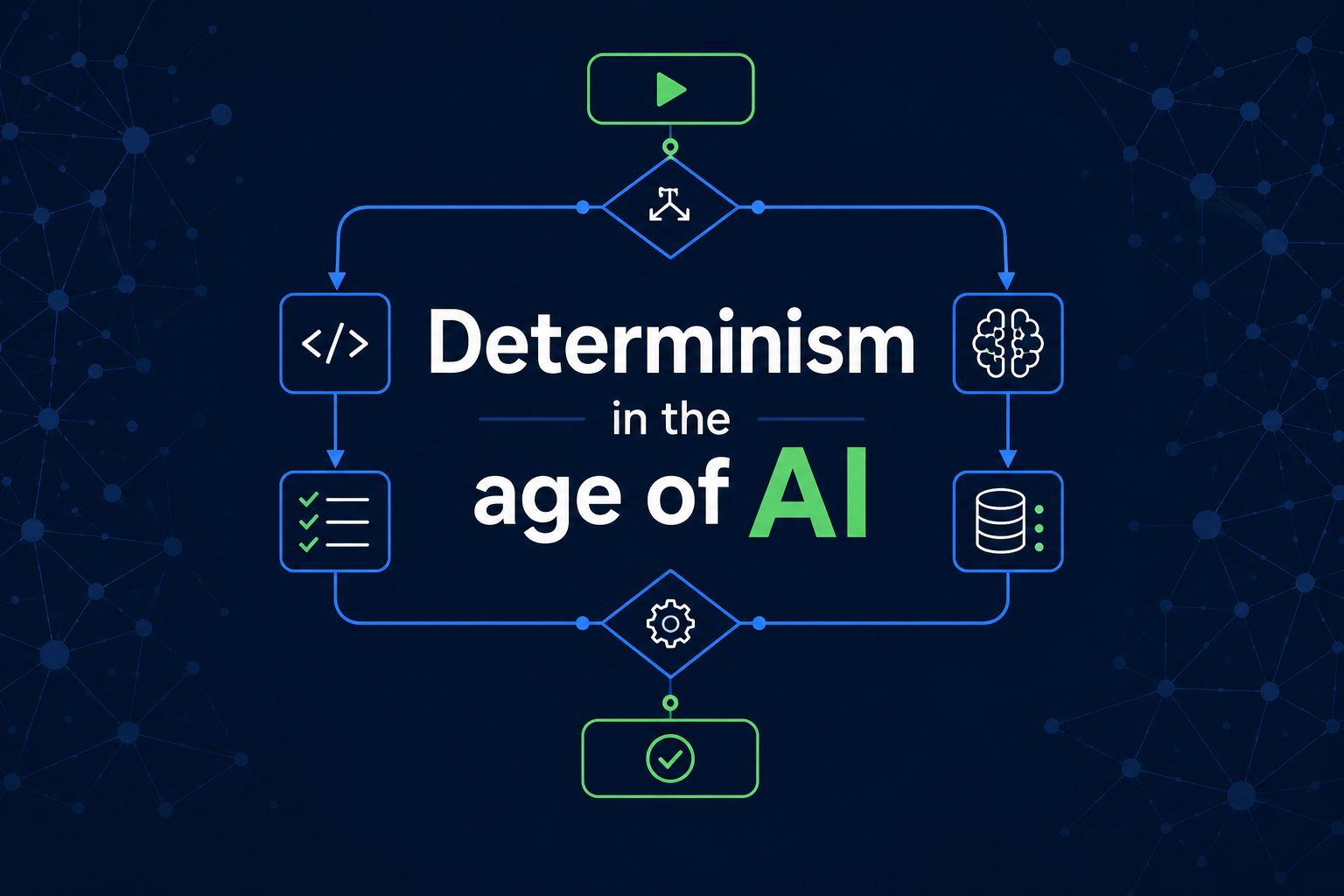
AI has completely changed what software teams can automate. Today, it can classify text, summarize documents, assist support teams, generate code, answer questions, and help users navigate complex workflows.
But not every part of a system should become probabilistic. In my experience building modular Python applications and scaling data processing systems, I've noticed that it is crucial to establish clear boundaries between where AI belongs and where explicit computation should remain.
When software calculates money, compliance status, payroll values, tax credits, risk exposure, or legally meaningful outputs, determinism still matters. A user should be able to ask, "why did the system produce this result?" and get a concrete answer, something better than "the model thought so."
In this post, we’re going to explore why deterministic systems are still essential, how AI fits perfectly around the edges, and what a practical hybrid architecture looks like.
Determinism Is a Product Feature
Deterministic systems produce the exact same output from the same input under the same version of code and configuration. That property sounds technical, but users feel it.
It means results can be explained. Bugs can be reproduced. Tests can be written. Auditors can inspect the logic. And engineers can compare outputs before and after a change.
For high-stakes workflows, this is not just an implementation preference. It is an integral part of the product promise. If the system affects a financial decision, the user needs absolute confidence that the calculation is repeatable.
AI Is Useful Near the Edges
This does not mean AI has no role. On the contrary, AI can be incredibly useful when built around deterministic pipelines.
It can classify messy documents before structured processing, suggest mappings for human review, and summarize long reports. It is also great at explaining results in natural language, assisting analysts with research, and helping support teams investigate failures.
These are all valuable capabilities. The important distinction is whether AI assists the workflow or owns the final calculation. In many regulated systems, AI is best used as a copilot around explicit computation, not as a replacement for it.
Pipelines Make Behavior Visible
A deterministic pipeline exposes its behavior explicitly through code and contracts. Schemas define expected inputs, while transformations describe exactly how data changes. Mappers connect actions to implementations, configuration defines allowed variants, tests verify known edge cases, and versioned artifacts preserve the final outputs.
That visibility lets engineers and domain experts collaborate seamlessly. A lawyer, accountant, analyst, or operations specialist may not read every line of code, but the team can still trace the logic from input to output.
With a black-box AI model, that conversation becomes significantly harder.
Repeatability Beats Plausibility
AI systems are often great at providing plausible answers. Business-critical systems, however, need correct and repeatable answers.
If a calculation changes, the team should be able to identify exactly why. Whether the input data changed, a business rule was updated, a configuration value was modified, a bug was fixed, or an external rate table shifted: these are all concrete explanations. They support debugging, release notes, customer communication, and audit trails.
"The model responded differently this time" might be acceptable for a draft summary, but it is nearly impossible to defend for a financial result.
Deterministic Does Not Mean Rigid
There is a common misconception that deterministic systems cannot evolve quickly. They absolutely can, provided they are designed well.
Use configuration for reference data, use versioned inputs, keep your mappings explicit. Store outputs under traceable paths. Build artifacts that product APIs can consume without rerunning heavy work.
That kind of architecture can support rapid domain evolution while keeping every calculation reviewable. The goal is not to hard-code everything forever. The goal is to make change intentional.
A Practical Hybrid
A strong, modern architecture strikes a balance. To keep things clean and easy to scan, here is what that hybrid approach might look like:
- AI helps classify or interpret unstructured inputs.
- Humans review uncertain or high-impact decisions.
- Deterministic pipelines perform the final calculations.
- APIs expose status, summaries, and clear explanations.
- Audit logs preserve exactly who changed what, and when.
- Versioned artifacts make outputs fully reproducible.
This setup gives the system ample room to benefit from AI without handing its most sensitive responsibilities over to a probabilistic layer.
Final words
AI is undeniably a powerful tool, but it does not remove the need for explicit systems engineering. For workflows where correctness, repeatability, and auditability matter, deterministic pipelines remain one of the best tools we have. They are testable, inspectable, rerunnable, and explainable.
By keeping AI near the edges to assist workflows and letting pipelines make your system's behavior visible, you can build applications that are both smart and reliable. The future isn't a battle of AI versus deterministic systems. It's about knowing which parts of the workflow need judgment, which need assistance, and which need to be exact every single time.